Exposiciones Bogota 2026
While preparing DO YOU REMEMBER DO YOU NO I DON'T - a new music theatre performance at the operahouse in Bogota TEATRO COLON, Heiner Goebbels will also present two video- and sound installations at Gallery Edificio Taller CRA 12 ' 19-72 - running from May 15th to June 20th.
Seven Columns
The Fish Will Have to Learn to Walk on Land
curatorial statement: SPANISH
(for ENGLISH scroll down)
“La historia es una ruina desde la que se puede mirar hacia adelante” — Heiner Müller
Edificio Taller no funciona exactamente como una galería ni como un estudio. Ha ido tomando forma como un lugar donde Nova et Vetera, en alianza con Muaré Costumes, prolonga encuentros construidos durante años con artistas que llegan a Colombia desde una relación de confianza, trabajo y conversación previa.
Heiner Goebbels llega ahora a Bogotá por una invitación curatorial de Nova et Vetera y por una historia que no empieza aquí. Desde 2019, gracias a la gestión y el entusiasmo de la Dirección de Patrimonio Cultural de la Universidad Nacional, se presentó: It´s Beautiful Here, anthology of sounds and spaces, una retrospectiva que combinó formatos de concierto, obra de teatro e instalación artística para sitio específico en el Auditorio León de Greiff, el laboratorio de Hidráulica y el Museo de Artes de la Universidad Nacional bajo la curaduría de Maria Belen Saéz de Ibarra y Santiago Gardeazábal.
En este 2026, su presencia en Colombia abre una nueva ocasión poco común: crear una nueva obra para el Teatro Colón comisionada por el Centro Nacional de las Artes y Nova et Vetera, al mismo tiempo, compartir con otros públicos, artistas, técnicos y equipos de trabajo colombianos algunas de las preguntas que atraviesan su manera de entender la escena.
En Edificio Taller, las instalaciones permiten que ese encuentro no se agote en su residencia de trabajo, los días de ensayo o en las funciones. Abren otro tiempo, más lento y más cercano, para entrar en contacto con sus materiales, sus imágenes, sus sonidos y sus formas de pensamiento. También permiten que algo de su paso por Colombia quede como una estela: una posibilidad de seguir conversando.
Para Edificio Taller este tipo de proyectos parte de una convicción sencilla: cuando artistas como Goebbels aceptan venir al país, no se trata únicamente de presentar una obra. Se trata también de crear condiciones para que su presencia dialogue con nuestro contexto, con sus saberes, con sus oficios y con las personas que hacen posibles las artes vivas en Colombia.
La llegada de Heiner Goebbels ocurre en el contexto de Lo Sagrado Universal, ciclo propuesto por el Ministerio de Cultura de Colombia a través de una alianza de coproducción entre el Teatro Colón / Centro Nacional de las Artes y Nova et Vetera para el estreno mundial de DO YOU REMEMBER DO YOU NO I DON’T. Durante varias semanas, músicos, performers, bailarines y técnicos -en su mayoría vinculados a Colombia- desarrollaron ensayos e improvisaciones entre el Teatro Colón y el Taller de la Sabana. Allí, una pluralidad de prácticas se activó como condición de trabajo: música contemporánea, improvisación, performance experimental, sonido, movimiento y múltiples formas de experiencia material.
En paralelo a esa creación escénica, Edificio Taller presenta Seven Columns y The Fish Will Have to Learn to Walk on Land, dos configuraciones espaciales dónde sonido, imagen, cuerpos, objetos y arquitectura organizan experiencias basadas en resonancias, desplazamientos y atención compartida.
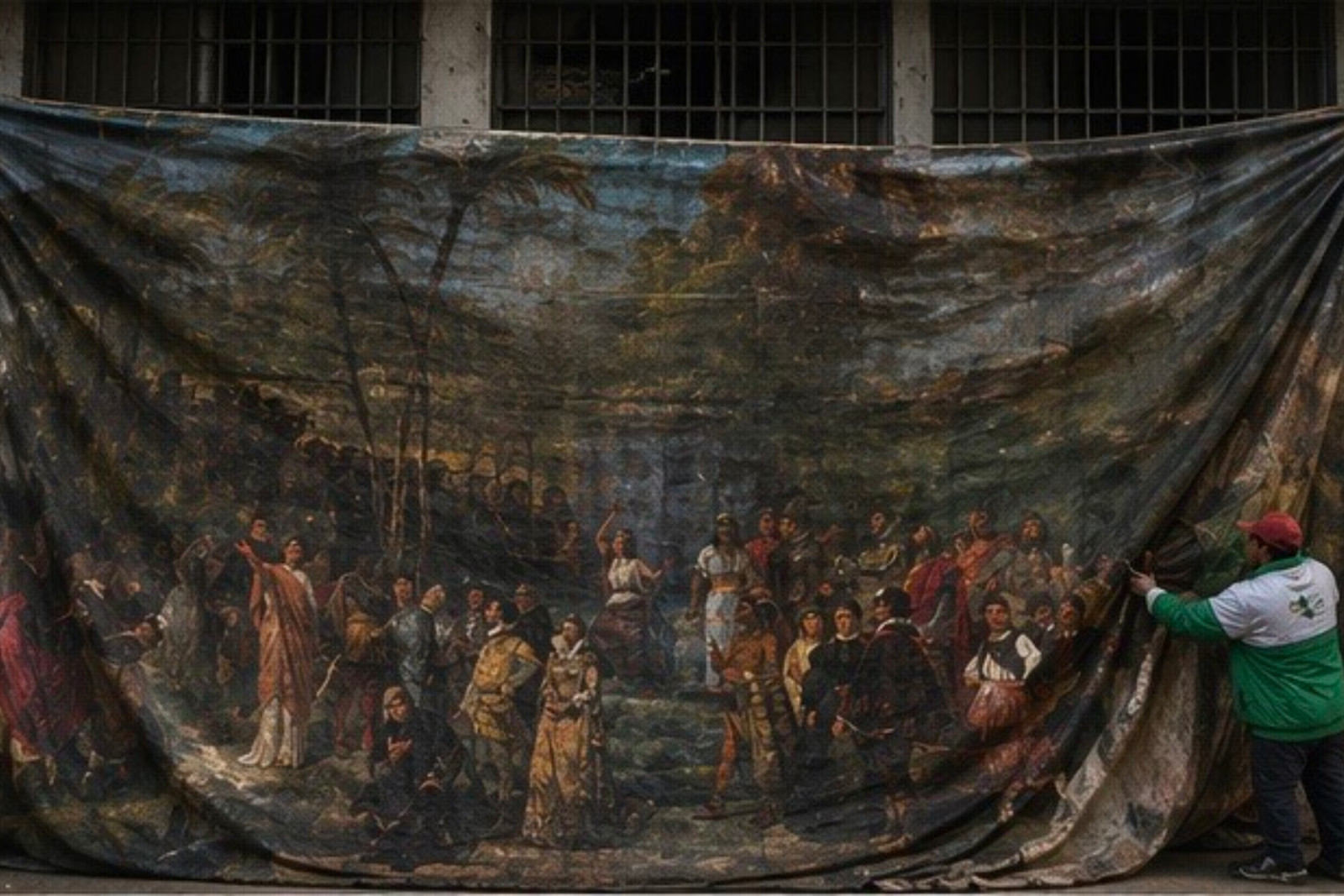
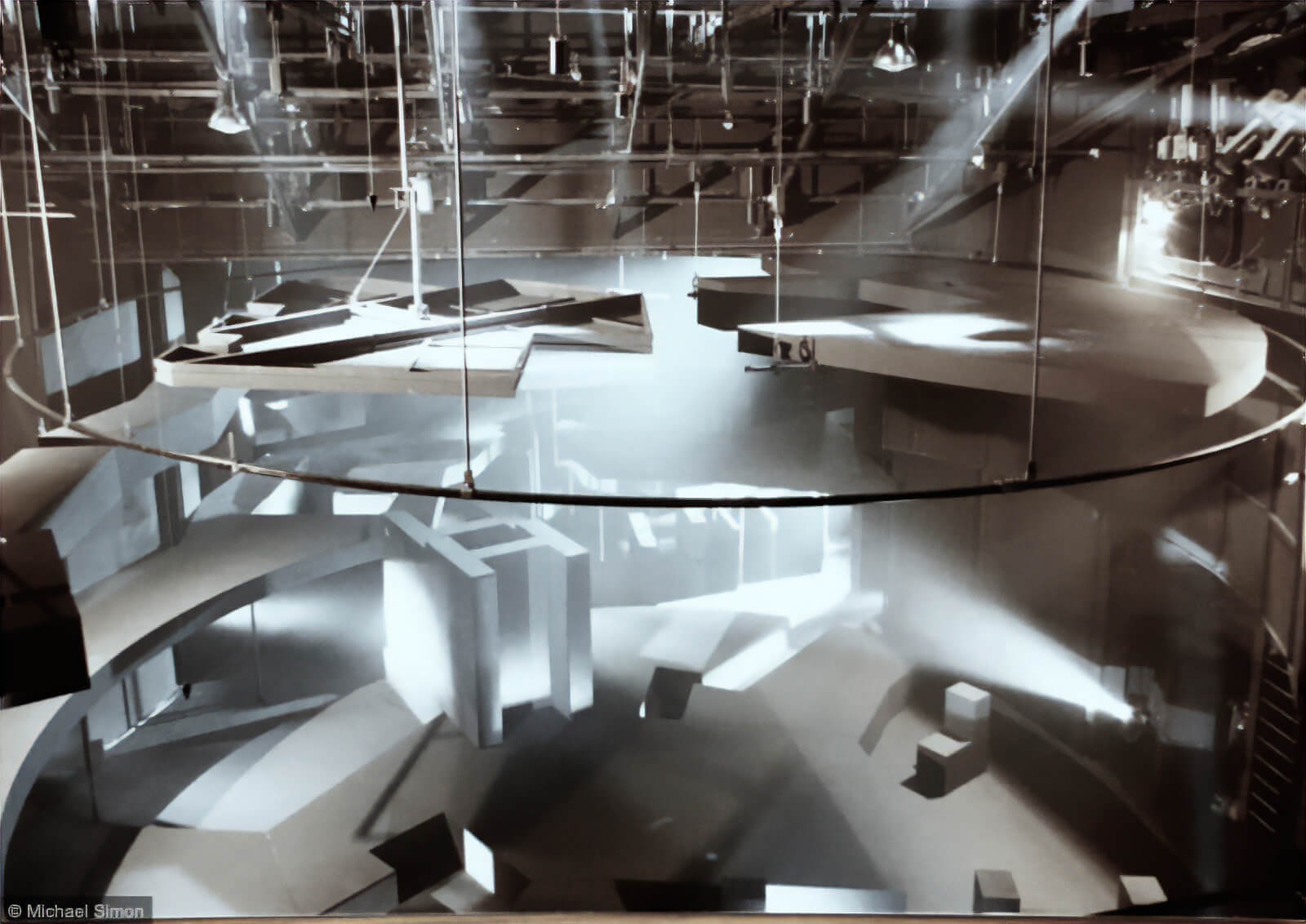
Seven Columns surge de Everything that Happened and Would Happen, una de las creaciones más ambiciosas de Goebbels. Fragmentos de historia europea, cuerpos, ruinas, agua, luz y sonido se reorganizan allí como un paisaje perceptivo. Los materiales -objetos, superficies, reliquias teatrales y elementos escénicos- quedan expuestos a nuevos usos y temporalidades. La instalación construye un espacio donde las narrativas dominantes se presentan en estado de ruina y donde la percepción se organiza a partir de resonancias entre cuerpos, objetos y sonidos.
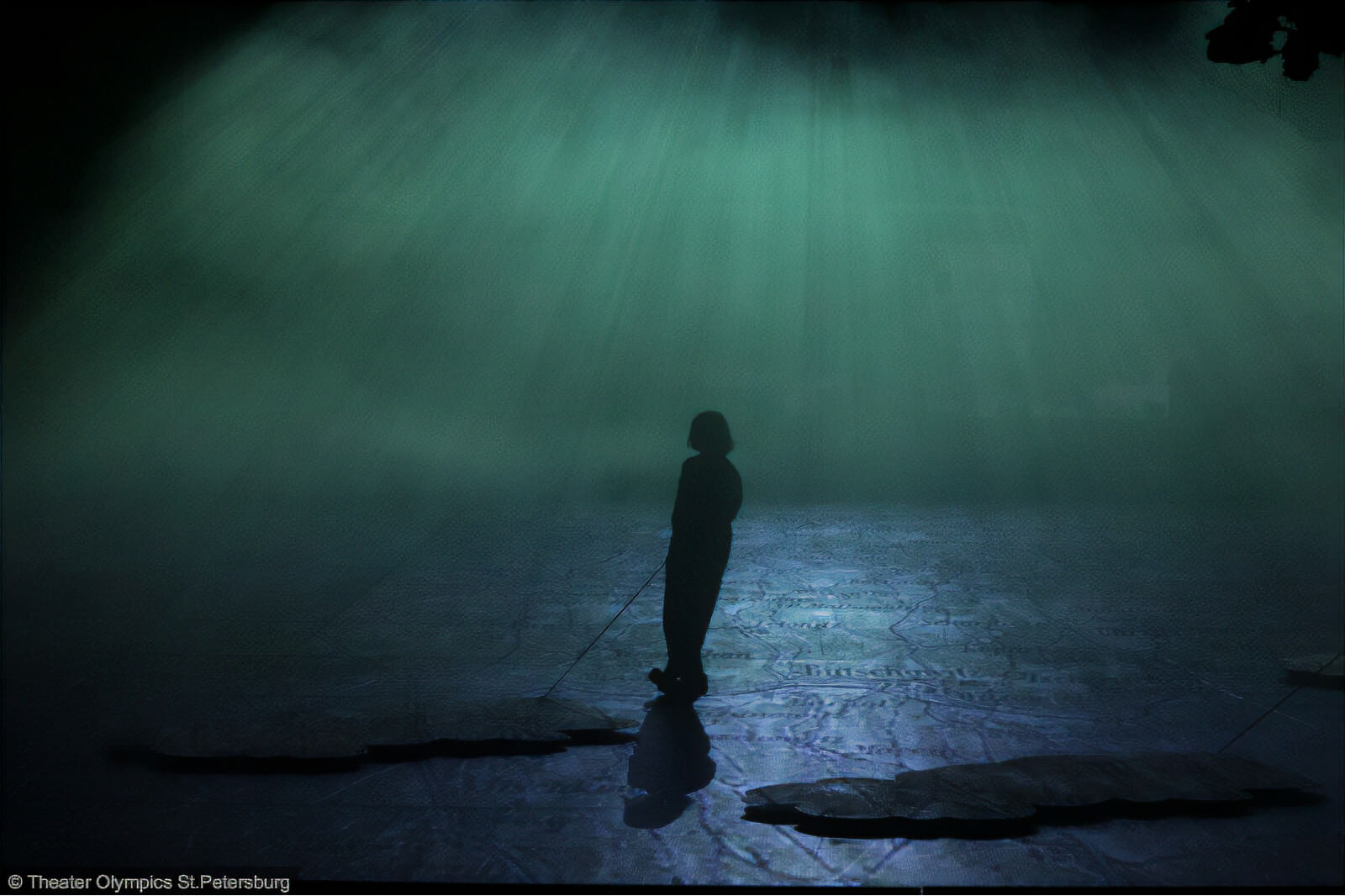
The Fish Will Have to Learn to Walk on Land, realizada junto a René Liebert, prolonga y transforma la instalación performática presentada previamente en el Museo de Arte de la Universidad Nacional de Colombia. Aquí, luz, reflejo, arquitectura, vacío y proyección conforman una coreografía espacial donde lo performático se desplaza más allá del cuerpo humano y se distribuye sobre superficies, ritmos y presencias materiales.
La materia ocupa un lugar central en esta constelación de trabajos. En la nueva creación de Goebbels para el Teatro Colón, objetos, vestuarios y fragmentos provenientes de archivos locales de teatro y ópera reaparecen como agentes activos dentro de la escena: reliquias desplazadas, reutilizadas y transformadas. Esa atención hacia los materiales y sus memorias atraviesa también Edificio Taller, un espacio habitado por impresión, costura, cocina, construcción escénica y múltiples oficios.
Goebbels ha pensado durante décadas la escena como un espacio de escucha, colaboración y construcción colectiva. Esa dimensión atraviesa tanto su trabajo artístico como su larga labor pedagógica en la Justus-Liebig-Universität de Gießen y su dirección artística de la Ruhrtriennale entre 2012 y 2014. En Colombia, esa experiencia se comparte también con los equipos técnicos y humanos que hacen posible cada montaje, cada ensayo y cada forma de aparición pública.
En su obra, el teatro aparece como una forma de atención compartida antes que como un dispositivo de explicación. Sus trabajos despliegan cuerpos polifónicos cuyas acciones siguen lógicas de resonancia más que dramaturgias de causa y efecto. El sentido se ensambla, se desplaza y se reorganiza entre performers, materiales y espectadores.
Las instalaciones reunidas aquí prolongan esa búsqueda. Organizan un espacio donde tensiones, fragmentos, sonidos, imágenes y residuos históricos permanecen visibles sin resolverse por completo. La experiencia se construye desde la coexistencia de temporalidades, desde la persistencia de las grietas y desde una atención sostenida hacia aquello que todavía continúa actuando en el presente.
************************
Créditos
Heiner Goebbels
The Fish Will Have to Learn to Walk on Land, 2025
Instalación de video, video a 6 canales, color, sonido surround a 6 canales, proyectores, parlantes, monitor de 10 pulgadas, láminas de polietileno, etc.20 min, dimensiones variables. Comisionada por Busan MoCA.
Colaboración artística y videos: René Liebert — registrado en 2019 durante la instalación performativa de Heiner Goebbels Los peces tendrán que aprender a caminar sobre la tierra, 2019, en Bogotá, Colombia, en Museo de Arte UNAL.
Heiner Goebbels
Seven Columns, 2023
Instalación sonora y de video multicanal, luz, agua y olas duracional (loop de 10 min)por Heiner Goebbels
registrado durante la performance Everything that happened and would happen de Heiner Goebbels en Park Avenue Armory, Nueva York, el viernes 7 de junio de 2019,por Da Ping Luo (cámara) y Jody Elff (sonido).
René Liebert: Dirección técnica y colaboración artística Benjamin Calais: Diseño sonoroCurador: Santiago GardeazábalProducción: Edificio Taller, Nova et Vetera y Muaré Costumes
curatorial statement, ENGLISH
“The story is a ruin from which one can look forward” — Heiner Müller
Edificio Taller does not operate exactly as a gallery or as a studio. It has gradually taken shape as a place where Nova et Vetera, in alliance with Muaré Costumes, extends encounters built over many years with artists who come to Colombia through relationships of trust, work, and ongoing conversation.
Heiner Goebbels now arrives in Bogotá through a curatorial invitation from Nova et Vetera and through a story that does not begin here. Since 2019, thanks to the initiative and enthusiasm of the Cultural Heritage Office of the National University of Colombia, It’s Beautiful Here: Anthology of Sounds and Spaces was presented: a retrospective that combined concert formats, theatre work, and site-specific installation at the León de Greiff Auditorium, the Hydraulics Laboratory, and the Museum of Art of the National University of Colombia, curated by María Belén Sáez de Ibarra and Santiago Gardeazábal.
In 2026, his presence in Colombia opens a new and uncommon occasion: to create a new work for the Teatro Colón, commissioned by the Centro Nacional de las Artes and Nova et Vetera, while also sharing with other audiences, artists, technicians, and Colombian work teams some of the questions that run through his way of understanding the stage.
At Edificio Taller, the installations allow this encounter not to be exhausted by his work residency, rehearsal days, or performances. They open another kind of time, slower and more intimate, in which to come into contact with his materials, images, sounds, and forms of thought. They also allow something of his passage through Colombia to remain as a trace: a possibility for the conversation to continue.
For Edificio Taller, this kind of project begins from a simple conviction: when artists such as Goebbels agree to come to the country, it is not only a matter of presenting a work. It is also about creating the conditions for their presence to enter into dialogue with our context, our knowledge, our crafts, and the people who make the living arts possible in Colombia.
Heiner Goebbels’s arrival takes place within the context of Lo Sagrado Universal, a cycle proposed by Colombia’s Ministry of Culture through a co-production alliance between the Teatro Colón / Centro Nacional de las Artes and Nova et Vetera for the world premiere of DO YOU REMEMBER DO YOU NO I DON’T. Over several weeks, musicians, performers, dancers, and technicians—most of them connected to Colombia—developed rehearsals and improvisations between the Teatro Colón and the Taller de la Sabana. There, a plurality of practices was activated as a working condition: contemporary music, improvisation, experimental performance, sound, movement, and multiple forms of material experience.
In parallel with this stage creation, Edificio Taller presents Seven Columns and The Fish Will Have to Learn to Walk on Land, two spatial configurations in which sound, image, bodies, objects, and architecture organize experiences based on resonance, displacement, and shared attention.
Seven Columns emerges from Everything that Happened and Would Happen, one of Goebbels’s most ambitious creations. Fragments of European history, bodies, ruins, water, light, and sound are reorganized there as a perceptual landscape. The materials—objects, surfaces, theatrical relics, and scenic elements—are exposed to new uses and temporalities. The installation constructs a space in which dominant narratives appear in a state of ruin, and where perception is organized through resonances between bodies, objects, and sounds.
The Fish Will Have to Learn to Walk on Land, created with René Liebert, extends and transforms the performative installation previously presented at the Museum of Art of the National University of Colombia. Here, light, reflection, architecture, emptiness, and projection form a spatial choreography in which the performative moves beyond the human body and is distributed across surfaces, rhythms, and material presences.
Matter occupies a central place in this constellation of works. In Goebbels’s new creation for the Teatro Colón, objects, costumes, and fragments from local theatre and opera archives reappear as active agents within the stage: displaced, reused, and transformed relics. This attention to materials and their memories also runs through Edificio Taller, a space inhabited by printmaking, sewing, cooking, scenic construction, and multiple crafts.
For decades, Goebbels has thought of the stage as a space of listening, collaboration, and collective construction. This dimension runs through both his artistic work and his long pedagogical practice at the Justus Liebig University Giessen, as well as his artistic direction of the Ruhrtriennale between 2012 and 2014. In Colombia, that experience is also shared with the technical and human teams that make each staging, each rehearsal, and each form of public appearance possible.
In his work, theatre appears as a form of shared attention rather than as a device for explanation. His works unfold polyphonic bodies whose actions follow logics of resonance more than dramaturgies of cause and effect. Meaning is assembled, displaced, and reorganized among performers, materials, and spectators.
The installations gathered here extend that search. They organize a space where tensions, fragments, sounds, images, and historical residues remain visible without being fully resolved. The experience is built from the coexistence of temporalities, from the persistence of cracks, and from sustained attention to what still continues to act in the present.
Credits:
Heiner Goebbels The Fish Will Have to Learn to Walk on Land, 2025
Video installation, 6-channel video, color, 6-channel surround sound, projectors, speakers, 10-inch monitor, polyethylene sheets, etc. 20 min., variable dimensions. Commissioned by Busan MoCA. Artistic collaboration and videos: René Liebert — recorded in 2019 during Heiner Goebbels’s performative installation The Fish Will Have to Learn to Walk on Land, 2019, in Bogotá, Colombia, at the UNAL Museum of Art.
Heiner Goebbels Seven Columns 2023
Multichannel sound and video installation, light, water, and durational waves 10-minute loop by Heiner Goebbels Recorded during the performance Everything that Happened and Would Happen by Heiner Goebbels at Park Avenue Armory, New York, on Friday, June 7, 2019, by Da Ping Luo, camera, and Jody Elff, sound.
René Liebert: Technical direction and artistic collaboration Benjamin Calais: Sound design Curator: Santiago Gardeazábal Production: Edificio Taller, Nova et Vetera, and Muaré Costumes