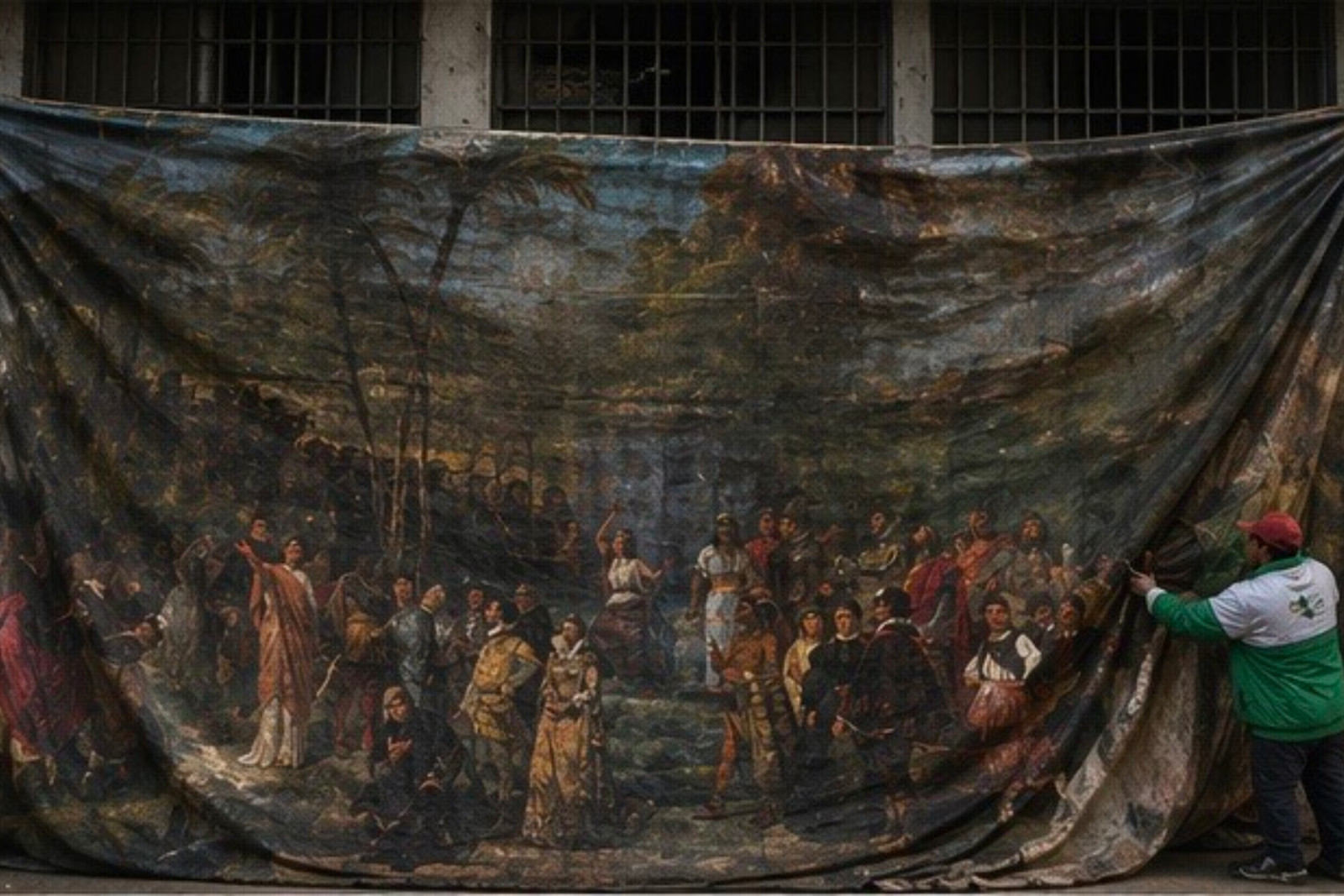
In the context of SACRED UNIVERSAL Heiner Goebbels offers to develop a new work for Teatro Colón / CNA in Colombia.
The work unfolds as a contemporary mystery play, understood not as a religious genre but as a communal form that allows contradictions to coexist without resolution. Mystery here refers to shared uncertainty rather than transcendence, to shared attention rather than shared belief. The performers form a polyphonic body whose internal agreements remain largely invisible. What is perceptible instead is a careful economy of listening, mutual observation, and response. Actions follow a logic of resonance between bodies, objects, sounds, and spaces, rather than a dramaturgy of cause and effect.
Around 15 performers, musicians, dancers, and movers - the majority based in or connected to Colombia - come together over some weeks of rehearsals and improvisations. Their backgrounds traverse contemporary music, improvisation, experimental performance, and diverse traditions and practices. This plurality is not curated as representation but activated as a working condition. Polyphony is understood literally and structurally, as the coexistence of distinct voices that do not merge into a single idiom.
Material and the confrontation with materials plays a central role. Objects, stage elements, costumes, and scenic fragments drawn from local theatre and opera archives become active agents rather than illustrative props. These relics of European theatrical history, already marked by travel and adaptation, are handled, displaced, combined, and sometimes rendered dysfunctional. Their presence points not only to artistic traditions, but also to histories of cultural dominance, representation, and exclusion that accompanied colonial expansion. The stage becomes a site where these materials are neither restored nor destroyed, but exposed to other temporalities and uses.
At the core of the project lies a simple but demanding principle: history is not presented as a linear account, nor as a moral lesson. Instead, it appears as a field of fragments, residues, gestures, musics, sounds and objects that continue to act in the present. As in his former work Everything that Happened and Would Happen (2018), the performance of DO YOU REMEMBER DO YOU NO I DON'T refuses to add yet another commentary to what has already been narrated countless times. It opens a space in which meaning is not delivered but assembled, dissolved, and reassembled by performers and audience alike.
The performance space becomes a landscape in which dominant narratives appear in a state of ruin. This landscape is not arranged to resolve tensions or to offer reconciliation, but to make coexistence perceptible. This does not produce harmony.
Tensions remain visible, sometimes uncomfortable. What holds the work together is not consensus, but music, sounds, images and a shared commitment to staying with complexity, to resisting closure, and to allowing gaps to persist.
The title is a quote from "Landscape with Argonauts" by Heiner Müller.